The Art of Scoring
Scoring is where all the magic comes together. That satisfying cut, the dramatic oven spring, the beautiful ear. It’s the final touch that transforms your dough into a masterpiece.
Scoring is one of the most difficult steps when baking bread at home. It requires practice, but luckily this guide will make things easier for you.
In this journey, you’ll learn:
- Why the 45° angle is essential
- How to score on a curved loaf surface
- Common patterns and techniques
- Troubleshooting when things don’t go as planned
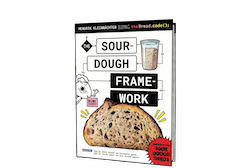
Based on The Sourdough Framework: Scoring Section.

Frequently asked questions
Does the curve of the scoring blade matter?
The angle and the sharpness matter more than the curve. A curved lame makes it easier to hold a shallow angle, which helps the ear, but a straight razor blade at about 45 degrees does the same job.
Why does my bread crack somewhere other than the score?
It cracks wherever the dough is weakest, often along the seam, when the score cannot open up enough. A deeper, confident cut, enough steam in the first half of the bake and not baking too hot let the loaf expand through the score instead.
Questions other bakers asked
Before You Score
Scoring is the final step before baking. Before you begin, make sure:
Oven Ready
- Preheated to 230°C (450°F) for at least 30 minutes
- Steam method ready (Dutch oven, water tray, or steam setting)
Dough Ready
- Properly fermented (30-50% volume increase during bulk)
- Shaped and proofed
- Cold from fridge is ideal (easier to score)
Surface Dry
- Dust with a little bit of flour after shaping
- A dry surface = clean cuts
If your dough is room temperature, consider 30 minutes in the freezer to firm it up before scoring.
Scoring Tools
The right tool makes all the difference.
Fresh razor blade
The cheapest and best option. Ultra sharp and gives you the cleanest cuts. Be very careful not to cut yourself!
Razor blade on handle (lame)
Sharp, flexible, professional choice. Safer to hold than a bare blade. Requires blade changes.
Curved lame
Perfect for curved cuts. Sometimes the blade can be hard to replace.
Very sharp knife
Multi-purpose option. May drag on dough if not razor-sharp.
The key is sharpness. A dull blade tears the dough instead of cutting cleanly. This ruins oven spring and creates ragged edges.
Blade maintenance:
- Change razor blades every 20-30 loaves
- Clean the blade from previous cuts before each use
- Rinse with water to remove any dough residue
Anatomy of a Score
Understanding what happens during baking helps you score better.
Parts of the Score:
- Incision: The cut you make
- Lip: The raised edge that becomes the ear
- Bloom: How the cut opens during baking
- Ear: The crispy flap that forms
What Creates the Ear:
When you score at an angle, one side of the cut is thinner. This thin flap rises and curls back during oven spring, creating the coveted ear.
Score straight down (90°) and you get no ear, just a flat opening. Score at 45° and the magic happens.
The 45° Angle on a Curved Surface
The 45-degree angle is the foundation of great scoring.
Why 45°?
- Creates a thin lip that curls into an ear
- Allows the dough to expand directionally
- Gives you that professional bakery look
The Challenge:
Your loaf has a curved surface like a dome. The “45° to the surface” changes depending on where you score. The angle that works at the top of the loaf is different from the sides.
The Solution:
Think of the angle relative to the surface at that exact spot, not relative to the table. Imagine your blade as a ramp slipping under the surface.
Drag the razor blade along the surface to see how the angle changes
At the center where the surface is flattest, 45° to the table equals 45° to the dough.
Always angle your blade 45° relative to the tangent (the imaginary flat surface) at the point where you’re cutting. On a round loaf, this means adjusting your wrist as you move along the surface.
Scoring Technique
Good scoring is about confidence and speed.
The Motion:
- Position: Hold blade at 45°, slightly off-center
- Commit: One swift, decisive motion
- Depth: Cut about 0.5cm (¼ inch) deep
- Length: Score about ⅔ of the loaf length
Common Mistakes:
- Going too slow (tears the dough)
- Too shallow (won’t open)
- Too deep (bread collapses, creates an overly dramatic “super ear”)
- Hesitating mid-cut (uneven score)
The Mindset:
Think of it like signing your name: fluid and confident. The more you hesitate, the worse it gets.
Practice Tips:
It takes practice. Your first score might not be perfect, and that’s okay!
- Consider making bread rolls to get more scoring practice
- Try practicing on freshly kneaded dough: make a nice smooth round surface and practice your cuts. It’s a great exercise before you commit to your final loaf.
Scoring Patterns
Once you master the basic slash, try these classic patterns:
Functional Patterns
╱ Single Slash
One diagonal cut, slightly off-center.
Best for: Batards
✕ Cross
Two perpendicular cuts forming an X.
Best for: Boules
▢ Square
Four cuts forming a square on top.
Best for: Round loaves
∧ Chevron
V-shaped pattern pointing forward.
Best for: Batards
Decorative Patterns
🌾 Wheat stalk
Angled cuts along a central line.
🍃 Leaf
Branch pattern with veins.
🌀 Spiral
Circular pattern from center outward.
Start with the single slash. Master the basics before adding complexity.
Troubleshooting
When scoring doesn’t go as planned, here’s what to check:
Problem: Scores sealed up / no oven spring
- Is your oven at the right temperature? Try 200-230°C (390-450°F). 230°C is recommended, but experiment.
- Measure your oven temperature with a thermometer. If too hot, the crust forms too fast and the score can’t open.
- Did you have enough steam?
- Is your dough over-fermented?
Problem: Bread is flat overall
This isn’t a scoring issue, it’s fermentation.
- Is your dough properly fermented? If it is, it will rise. If not, it won’t rise at all.
- Over-fermented dough has exhausted its rise and becomes leaky.
- Return to bulk fermentation basics
Problem: No ear formed
- Was your angle shallow enough (45°)?
- Did you score deep enough (about 0.5cm / ¼ inch)?
- Was the blade sharp?
Problem: Dough tore instead of cutting cleanly
- Is your blade sharp?
- Was the surface too wet?
- Did you cut too slowly?
You're Ready!
Congratulations! You’ve mastered the fundamentals of scoring.
📐 45° to the surface
📏 0.5cm deep
⚡ Swift motion
❄️ Cold dough
🔪 Sharp blade
Every loaf is a chance to improve. Don’t be afraid to experiment!
Ready to bake? Continue to Baking Timer.
Powered by The Sourdough Framework
Support Loafy by buying the book or leaving a donation.